Basement Waterproofing in Indianapolis, IN
Interior drainage systems, vapor barriers, and sump pump installation for wet or leaking Indianapolis basements. Transferable lifetime warranty. Free on-site estimate.
Call (317) 676-5519Basement water intrusion is the most common foundation problem in the Indianapolis metro. Indiana's clay soils hold water and expand against foundation walls during wet periods; when that water finds a path through the wall — through cracks, through the cove joint where the wall meets the floor, or through porous concrete block — it enters the basement. The Indianapolis area's seasonal rainfall pattern, with heavy spring rains followed by drier summers, creates exactly the seasonal wet/dry cycle that drives this problem. Indianapolis Foundation Pros installs interior drainage systems and sump pump systems that manage water at the source, keeping basements permanently dry regardless of what's happening in the soil outside.
We focus on interior waterproofing rather than exterior excavation for most Indianapolis homes because interior systems are more effective, less disruptive, and far less expensive than digging up the exterior of a foundation. Interior drainage channels the water that enters the wall-floor joint into a perimeter system before it can flood the basement floor — addressing the water that's going to find its way in regardless of exterior conditions. A properly installed interior drainage system manages water permanently, not temporarily.
Why Indianapolis Basements Get Wet
Understanding why your basement gets water is the first step to solving the problem correctly. The Indianapolis metro sits on glacially deposited clay soils that are highly expansive — they absorb water, swell, and exert lateral pressure on foundation walls. When soil against the foundation becomes saturated (from rain, irrigation, snowmelt, or a high water table), several things happen simultaneously: the soil pressure against the wall increases, water seeks any available path through the foundation, and hydrostatic pressure builds in the soil around the footing.
The most common entry points for water in Indianapolis basements:
- Cove joint — where the basement wall meets the floor; hydrostatic pressure pushes water up through this joint as the soil around the footing saturates
- Wall cracks — vertical, horizontal, and diagonal cracks provide direct paths for water to move from saturated soil into the basement
- Porous block — concrete block foundations (very common in Indianapolis homes built from the 1950s through 1980s) allow water to migrate through the hollow cores of the blocks
- Window wells — basement window wells that aren't properly drained or are below grade fill with water that then seeps through the window frame
- Floor cracks — hydrostatic pressure from a high water table can push water up through cracks in the basement floor slab
Our Waterproofing Methods
Interior Perimeter Drainage System
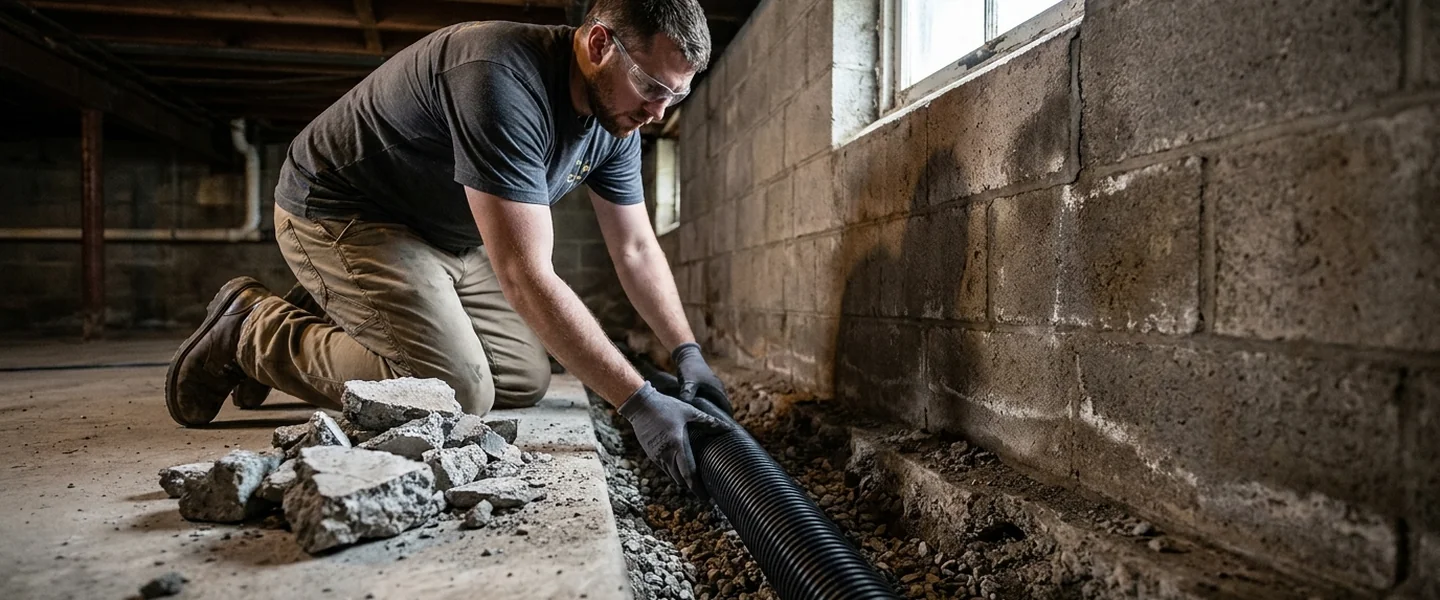
An interior perimeter drainage system is the most effective long-term solution for basement water intrusion in Indianapolis. We install a drainage channel along the inside perimeter of the basement wall, at or below the floor level, that captures water entering through the wall-floor cove joint and directs it to a sump pump. The channel is covered with a concrete cap flush with the existing floor — clean, invisible, and permanently functional. This system works regardless of the exterior soil conditions or water table level because it manages the water that's going to enter rather than trying to stop it from the outside.
Vapor Barrier Systems
For block foundation walls, we install a drainage membrane — a dimple mat or studded vapor barrier — against the interior surface of the wall. This membrane channels water that seeps through the block wall downward to the perimeter drainage system, keeping moisture off the wall surface and preventing the condensation and mold growth that accompany chronic damp basement walls. The membrane also creates a thermal break that reduces condensation on the wall surface during Indiana's humid summers.
Sump Pump Installation and Replacement
Every interior drainage system terminates at a sump pump that discharges the collected water away from the foundation. We install sump pumps sized for the expected water volume — Indianapolis's spring rains can produce significant water volumes in a short period, and an undersized pump that can't keep up defeats the purpose of the drainage system. We also install battery-backup secondary sump pumps on every installation: Indiana storms frequently cause power outages, and the heaviest rains and highest water tables often coincide with power failures.
Project Details
| Installation Timeline | 1–2 days for most Indianapolis residential basements |
|---|---|
| Disruption Level | Interior work only; no excavation of exterior landscaping or driveways |
| Sump Pump Type | Submersible primary pump + battery-backup secondary; sized for Central Indiana rainfall volumes |
| Drainage System | Perimeter channel at cove joint; concrete cap at floor level; directs to sump basin |
| Warranty | Transferable lifetime warranty on drainage system; covers failure to keep basement dry |
| Pricing | Quoted per job after free on-site assessment — scope depends on linear footage and basement conditions |
Our Waterproofing Process
- 1On-Site Assessment — We inspect your basement, identify all water entry points, assess the soil and drainage conditions, and determine the correct system scope. You get an honest assessment of what's causing the problem — not a sales pitch for the most expensive system.
- 2Written Estimate — Written flat estimate covering linear footage of drainage installation, pump specification, any vapor barrier scope, and warranty terms. The estimate is the price — we don't add scope on installation day.
- 3Perimeter Channel Installation — Concrete is saw-cut along the interior perimeter, the drainage channel is set, and the concrete cap is poured. Concrete debris is cleaned and removed from the basement.
- 4Sump Basin and Pump Installation — Sump basin installed in the lowest point of the basement; primary submersible pump and battery-backup pump installed; discharge line run to exterior, away from the foundation.
- 5Vapor Barrier (If Applicable) — Block wall drainage membrane installed against the wall surface, directing seeping moisture downward to the perimeter channel. Sealed at top and bottom.
- 6System Test and Warranty Documentation — System tested before we leave. Warranty documentation registered to your property address at job completion.
Indianapolis-Specific Waterproofing Considerations
The Indianapolis metro has several localized factors that affect basement water conditions. Homes in the Irvington and Broad Ripple neighborhoods — older neighborhoods near White River and Fall Creek — sit in lower-elevation positions relative to these waterways, resulting in higher seasonal water table levels than neighborhoods on higher ground. The Hamilton County suburbs (Carmel, Fishers, Noblesville) have extensive irrigation systems in established subdivisions that keep soil moisture elevated through the summer growing season, maintaining ground moisture pressure against foundations year-round rather than just during rain events.
Indianapolis homes built from the 1950s through the 1970s — particularly those in the Lawrence, Southport, and Beech Grove areas — frequently have hollow-core concrete block foundations rather than poured concrete. Block foundations are more permeable to water migration than poured concrete, and the hollow cores of the blocks can fill with water that then seeps through the mortar joints into the basement. Vapor barrier drainage membranes on block walls are particularly important in these homes.
Warranty in Detail
Our interior drainage and waterproofing system installations carry a transferable lifetime warranty: if the basement gets water through the areas covered by the drainage installation, we return and correct it at no charge. The warranty transfers to new owners at the time of home sale — no paperwork burden, just notify us of the ownership change.
What the warranty covers: water intrusion through the wall-floor cove joint in the drainage footprint, pump failure if the pump fails within the warranty period and is not the result of power failure or neglect. What it doesn't cover: new water entry points that develop outside the drainage footprint (new cracks in areas not covered by the drainage installation), sump pump failure due to power outage (the battery-backup addresses this separately), and water intrusion through above-grade openings or window wells not included in the scope.
How We Quote Basement Waterproofing
Waterproofing quotes are based on the linear footage of perimeter drainage installation, the basement's water entry pattern (which determines where the drainage needs to go), the pump specification appropriate for the expected water volume, and whether a vapor barrier is needed for a block foundation. We don't charge for the assessment, and we don't pad quotes with scope that isn't needed for your specific basement. Call (317) 676-5519 to schedule your free on-site assessment.
After Your Basement Is Waterproofed
After installation, test your sump pump periodically — pour water into the basin to confirm the float activates correctly and the pump discharges. Check the battery-backup battery annually and replace it per the manufacturer's schedule (typically every 3–5 years). Keep the discharge line outlet clear of debris and snow accumulation through winter. We do a follow-up inspection at 30 days to confirm the system is performing correctly and that no adjustment is needed to the drainage channel or discharge routing.
Basement Waterproofing FAQ — Indianapolis, IN
Is interior waterproofing better than exterior waterproofing?
For most Indianapolis homes, interior drainage is more practical and more effective as a long-term solution. Exterior waterproofing (excavating around the foundation and applying a membrane to the outside of the wall) is extremely expensive, destroys landscaping, and doesn't address water that enters through the floor cove joint. Interior drainage manages the water that's going to find its way in regardless — which is the more honest approach for most Indianapolis soil conditions.
My basement only gets wet in heavy spring rains — do I still need waterproofing?
Seasonal water intrusion — even if it only happens a few times a year — causes progressive damage. Standing water encourages mold, degrades flooring and drywall, and creates the humidity that drives wood rot and structural decay over time. The damage is cumulative; what's a manageable annoyance today becomes significant structural repair in 10–15 years. If your basement gets water, addressing it with a permanent drainage system is more economical long-term than treating the symptoms repeatedly.
Do you need to excavate the outside of my house?
For most Indianapolis waterproofing projects, no. Our interior drainage system approach requires no exterior excavation — we work entirely from inside the basement. Your landscaping, driveway, and foundation plantings stay undisturbed. The only exterior work is routing the sump discharge line away from the foundation, which requires a small surface-level trench or bore through the foundation wall.
What happens if the power goes out during a storm?
We install a battery-backup sump pump as a standard component of every waterproofing system. The battery-backup activates automatically when the primary pump loses power, maintaining drainage through the storms that are most likely to cause flooding — precisely the scenario when power failures and heavy rain coincide. Battery-backup capacity is sized for Indianapolis's typical storm duration; extended outages may require monitoring the battery level.
Will waterproofing help with my basement humidity and mold smell?
Yes — significantly. The musty smell in chronically damp basements comes from mold and mildew growing in the humid environment created by water infiltration and evaporation. Eliminating the water source and adding a vapor barrier on block walls dramatically reduces basement humidity. Most homeowners notice the difference within weeks of installation. Existing mold should be remediated separately — waterproofing prevents future growth but doesn't remove existing colonies.
How long does basement waterproofing take?
Most Indianapolis residential basements take one to two days: Day 1 for concrete cutting, channel installation, and sump basin installation; Day 2 for concrete cap pour, pump installation, and cleanup. The concrete cap needs to cure before heavy traffic — typically 24 hours before placing items on it. We'll give you a specific timeline for your basement at the estimate visit.
Does the drainage system disrupt my finished basement?
Interior drainage requires removing a strip of concrete along the perimeter wall — typically 8–12 inches wide. In a finished basement, this means removing baseboard trim and a section of flooring along the perimeter. After installation, the area can be refinished. We discuss the specific scope for finished vs. unfinished basement sections at the estimate — a partially finished basement may be partially disruptive and partially not, depending on where the drainage footprint falls.
Is basement waterproofing covered by homeowners insurance?
Standard homeowners insurance typically doesn't cover basement waterproofing systems or foundation water damage from gradual infiltration. Some policies cover sudden water events (pipe burst, appliance failure) but not chronic water intrusion. Flood insurance through NFIP covers flooding from external sources in designated flood zones. We can discuss what documentation you might need for an insurance claim if you believe your damage may qualify, but we don't make insurance determinations.
Basement Waterproofing — Indianapolis Metro
Interior drainage standard. Battery-backup sump pump. Transferable lifetime warranty. Free on-site estimate.
Call (317) 676-5519Related Services
What You Get in Our Quote vs. the Lowball Bid
We don't compete on the lowest sticker price — we compete on the quote that gets the job actually done. Here is what is included in every quote we write, and the cut-corners that show up in cheaper bids.
Included in our written quote
- Engineer-style elevation + crack assessment
- Soil and drainage evaluation
- Written quote with pier counts + warranty terms
- Photo documentation of every crack/movement
- Permit-pulling where required
- Post-install elevation re-check
Cut corners in the lowball bid
- Free-quote with no actual inspection
- Pier-count guesses without measurements
- Subcontracted installation crews
- Warranties that exclude common failure modes
- Pressure to sign at the kitchen table
- Same-day pricing tricks