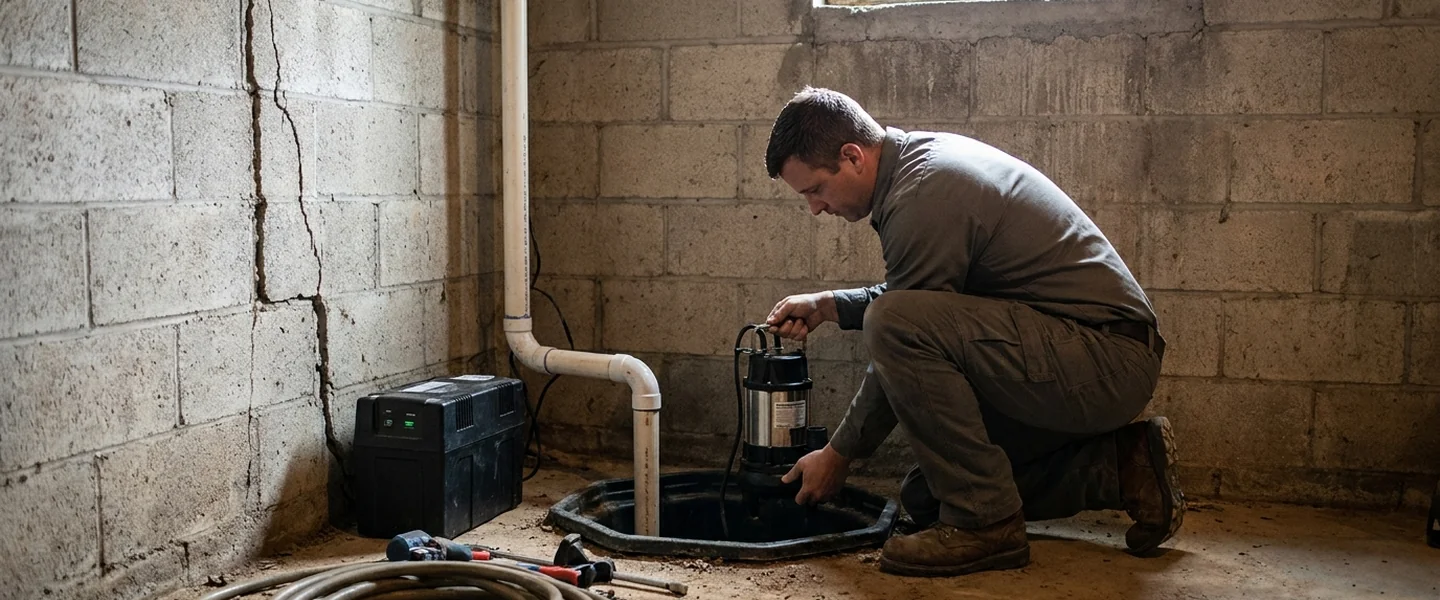
Sump Pump Installation in Indianapolis, IN
Primary submersible sump pump with battery-backup secondary — sized for Central Indiana rainfall volumes. Protects your basement through power outages and peak storm events. Free on-site estimate.
Call (317) 676-5519A sump pump is the last line of defense between water in your basement and a dry floor. Every interior drainage system — whether a full perimeter channel or a standalone sump basin — depends on a pump that works reliably, handles the volume of water during Indianapolis's peak spring rain events, and keeps running when the power goes out. Indianapolis Foundation Pros installs sump pump systems engineered for Central Indiana's specific conditions: submersible primary pumps sized for your basement's drainage volume, with battery-backup secondary pumps that activate automatically when the primary loses power.
Indianapolis's rainfall pattern creates exactly the scenario that tests sump pumps hardest. Spring storms dump two to four inches of rain in 24 hours, saturating the clay soils around your foundation and sending large volumes of water into the drainage system in a short window. These same storms frequently knock out power. A sump pump that can handle normal rain but can't keep up with a heavy spring event, or that stops when the lights go out, fails at the moment it matters most.
Why the Sump Pump System Matters More Than the Pump Alone
Homeowners often focus on the pump itself — horsepower rating, brand — but the pump is only one component of a system. A high-capacity pump installed in an undersized basin creates a rapid cycling problem that shortens pump life. A properly sized pump in a basin with no backup fails during a power outage. A correctly specified system accounts for all of these components together:
- Basin size — the sump basin must hold enough water volume to allow the pump to operate in full cycles rather than rapid on/off cycling, which overheats motors and causes premature failure
- Pump capacity (GPH/GPM) — gallons per hour capacity must match the expected water inflow rate from the drainage system during peak conditions; undersized pumps run continuously without keeping up
- Discharge line diameter and length — flow restriction in an undersized or excessively long discharge line reduces effective pump capacity; the pump spec must account for total head pressure
- Check valve — prevents discharged water from flowing back into the basin when the pump stops; without one, the pump cycles immediately after shutting off
- Battery backup capacity — must be sized for the expected storm duration in Indianapolis; a backup that provides 4 hours of capacity during a 12-hour storm event fails partway through
- Discharge termination point — must terminate far enough from the foundation that the discharged water doesn't re-enter the drainage system; typically a minimum of 10 feet from the foundation wall
Our Sump Pump Installation
Primary Submersible Pump
We install cast-iron submersible sump pumps rated for the expected drainage volume in your basement. Cast-iron construction handles the heat generated during high-volume pumping better than thermoplastic housing pumps — important during the extended high-volume events Indianapolis springs produce. Float switch type, activation threshold, and pump capacity are specified for your basin size and drainage footprint. We don't install a generic pump from a home center shelf and call it a day — every installation is sized for the actual water volume your drainage system will produce.
Battery-Backup Secondary Pump
A battery-backup sump pump is a standard component of every sump pump installation we perform. The backup unit is a separate pump on its own float switch, powered by a dedicated 12V battery maintained by a trickle charger. When the primary pump loses power — or is overwhelmed by water volume beyond its capacity — the backup activates automatically. The backup float switch is set slightly higher than the primary switch so the backup only runs when needed, preserving battery life for actual emergencies.
We size the backup battery for 8–12 hours of pumping capacity, which covers the majority of Indiana storm events including typical power restoration times in the Indianapolis metro. Battery condition should be tested annually and replaced on the manufacturer's schedule (typically every 3–5 years).
Discharge Line Installation
The discharge line carries water from the pump to a termination point away from the foundation. We install rigid PVC discharge lines with check valves, routed to a discharge point at least 10 feet from the foundation — ideally toward a slope or drainage swale that naturally carries water away from the property. Underground discharge to a pop-up emitter is our preferred approach where site grading allows; it eliminates the surface-level discharge pipe that homeowners trip on and that freeze solid in an Indianapolis January.
Project Details
| Installation Timeline | Same day for most standalone sump pump replacements; 1 day for new basin installation with drainage integration |
|---|---|
| Primary Pump | Cast-iron submersible, sized by drainage volume and basin capacity |
| Backup Pump | Battery-backup secondary with 8–12 hour capacity; trickle-charged battery; automatic float activation |
| Discharge | Rigid PVC with check valve; termination minimum 10 feet from foundation; underground pop-up emitter preferred |
| Basin | Sized for proper pump cycle duration — undersized basins cause rapid cycling and shorten pump life |
| Warranty | Pump and installation warranty; battery-backup covered for 3 years; labor warranty for installation workmanship |
| Pricing | Quoted per job after free on-site assessment — scope depends on existing drainage, basin condition, and discharge routing |
Our Sump Pump Installation Process
- 1System Assessment — We evaluate your current sump setup (basin size, pump condition, discharge routing, backup status), the drainage system feeding it (interior perimeter channel or standalone), and the basement's water history. If you've never had water problems but want a preventive pump, we assess whether your basement has natural drainage into a basin or requires a new basin installation.
- 2Written Estimate — Complete written estimate: primary pump specification, backup pump specification, discharge routing plan, any basin work, and total installed cost. No open-ended material charges added after the fact.
- 3Basin Preparation — Existing basin cleaned and inspected, or new basin installed if required. Basin lid fitted with airtight seal to prevent radon and humidity from entering the basement from the basin.
- 4Pump Installation — Primary pump positioned and connected; float switch set at correct activation level; discharge line connected with check valve. Backup pump installed on separate float switch set 2 inches above primary activation level; battery connected and charger wired.
- 5Discharge Line Routing — Discharge line run through foundation wall or up through the basement ceiling, routed to termination point. Check valve installed. Underground pop-up emitter installed if applicable.
- 6System Test — Both primary and backup pumps tested by filling the basin and confirming activation, pumping, and proper float switch shutoff. Discharge termination confirmed to carry water away from foundation. Battery backup tested for proper activation when primary power is disconnected.
Indianapolis-Specific Sump Pump Considerations
Indianapolis's spring storm season — typically March through June — is when sump pumps earn their keep. The city averages 40+ inches of annual rainfall, with a significant portion concentrated in the spring months. Storms capable of dropping 2+ inches in 12 hours are common; the 100-year storm event for Indianapolis is approximately 5 inches in 24 hours. A pump installed without accounting for these peak volumes will run continuously during the heaviest events without keeping up.
Power outages during Indianapolis storms are frequent. The area experiences a higher rate of storm-related power interruptions than more sheltered metro areas because of the flat, open terrain that allows high-wind events from the southwest. The battery backup isn't an optional add-on here — it's the component that works during the storm most likely to flood your basement.
Homes near Eagle Creek, White River, Fall Creek, and Pogues Run — including parts of Speedway, the near-Westside, Broad Ripple, and Irvington — have higher seasonal water table levels that keep sump pumps running more consistently than homes on higher ground. In these areas, pump sizing for continuous operation (not just peak events) matters more than in drier-soil neighborhoods. We account for this in our pump selection for these locations.
In Hamilton County — Carmel, Fishers, Noblesville — heavily irrigated subdivisions maintain elevated soil moisture through the summer growing season. Sump pumps in these neighborhoods may run regularly through the dry summer months that wouldn't activate pumps in less-irrigated neighborhoods. Battery condition and pump cycle counts need monitoring in these installations.
After Your Sump Pump Is Installed
Test your pump periodically — pour a five-gallon bucket of water into the basin and confirm the float activates, the pump runs, and water discharges from the termination point. Do this before every heavy rain season (March in Indianapolis) to confirm the system is operational. Check the battery backup by disconnecting the primary power temporarily and confirming the backup activates.
Replace the battery backup battery on schedule — typically every 3–5 years depending on the manufacturer's recommendation and local cycle count. A battery approaching end of life may show charge but fail under load during an actual power outage. We include a battery replacement schedule in the documentation we leave after installation.
Keep the discharge termination point clear of debris and ice accumulation. An Indiana January can freeze a discharge line solid if the termination isn't properly protected — a frozen discharge with a running pump is a problem. Underground pop-up emitters are less susceptible to freeze issues than surface discharge; we'll advise on your specific installation.
Sump Pump FAQ — Indianapolis, IN
How do I know if my existing sump pump needs replacement?
Signs of a failing sump pump include: pump runs but water level in the basin doesn't drop (impeller worn or clogged), pump runs continuously without shutting off (float switch failure or undersized pump), pump makes unusual noise (bearing wear, debris in impeller), pump doesn't activate when the basin fills (float switch failure), or the pump is more than 7–10 years old without recent inspection. When in doubt, test it before the spring season — pour water in the basin and watch what happens. If you're not sure, call us and we'll assess the existing system.
What size sump pump do I need?
Pump sizing depends on the expected water inflow rate, which depends on the drainage system size, the soil saturation rate, and your basement's water history. A general residential basement with an interior perimeter drainage system needs a pump capable of handling 30–50 gallons per minute during peak conditions. We size the pump to your specific installation rather than recommending a generic "1/2 HP" without understanding the drainage context.
Do I really need a battery backup?
In Indianapolis, yes. The storms that saturate the soil and send the most water through the drainage system are also the storms that knock out power. The battery backup runs when the primary can't — and in Indianapolis that happens multiple times per year during spring storm season. A sump pump without a backup is a sump pump that fails when you need it most. We include a backup on every installation we perform.
My sump pump runs all the time — is that normal?
Running frequently during heavy rain or spring snow melt is normal. Running continuously for days without rain suggests a high water table issue, a plumbing leak, or an undersized pump that can't keep up. Continuous running without precipitation means the water source isn't rain — it's either groundwater from a persistently high water table or an internal water source (pipe, water heater, condensate). We can diagnose what's driving the continuous cycling and address the cause.
Where should the discharge line terminate?
At least 10 feet from the foundation, directed away from the property in a direction that naturally drains. Never into a sanitary sewer (illegal in Indianapolis — sump pump water goes to storm drainage, not the sanitary system), never adjacent to a neighbor's foundation, and never close enough to the house that the discharged water finds its way back into the soil against the foundation. We route the discharge line correctly during installation and advise you on the best termination point for your site.
How long does a sump pump last?
A quality submersible pump in a properly sized basin with appropriate cycle frequency should last 7–12 years. Factors that shorten pump life: undersized basin causing rapid cycling, running continuously during extended high-water conditions, pumping sandy or silty water that abrades the impeller, and deferred maintenance. We recommend annual inspection of float switch operation, discharge line condition, and basin cleanliness.
Can you install a sump pump without an existing drainage system?
Yes — a standalone sump basin and pump without perimeter drainage will collect water that naturally drains to the lowest point of the basement. This approach works when the basement has a single low point where water accumulates and a basin there will collect the inflow. It doesn't work when water enters through the wall-floor cove joint across a wide perimeter — that scenario requires interior perimeter drainage to direct the water to the basin. We assess which approach fits your basement's water entry pattern.
Is a Wi-Fi alert system worth it for the sump pump?
For Indiana homeowners, yes — particularly if you travel or don't check the basement regularly during storm season. A water sensor in the basin with a Wi-Fi alert will notify you if water is rising (pump failure or overwhelmed capacity) so you can respond before you have a flooding situation. We can integrate alert sensors into our sump pump installations; ask about this option during the estimate visit.
Sump Pump Installation — Indianapolis Metro
Submersible primary pump. Battery-backup secondary. Sized for Indiana storms. Free on-site estimate.
Call (317) 676-5519Related Services
What You Get in Our Quote vs. the Lowball Bid
We don't compete on the lowest sticker price — we compete on the quote that gets the job actually done. Here is what is included in every quote we write, and the cut-corners that show up in cheaper bids.
Included in our written quote
- Engineer-style elevation + crack assessment
- Soil and drainage evaluation
- Written quote with pier counts + warranty terms
- Photo documentation of every crack/movement
- Permit-pulling where required
- Post-install elevation re-check
Cut corners in the lowball bid
- Free-quote with no actual inspection
- Pier-count guesses without measurements
- Subcontracted installation crews
- Warranties that exclude common failure modes
- Pressure to sign at the kitchen table
- Same-day pricing tricks