Foundation Piering & House Leveling in Indianapolis, IN
Steel push piers and helical piers driven to load-bearing strata for permanent foundation stabilization and settlement recovery. Transferable lifetime warranty. Free on-site estimate.
Call (317) 676-5519Foundation settlement — where one section of your home's foundation drops lower than surrounding sections — is among the most serious and visible foundation failures. Sloping floors, sticking doors and windows, diagonal cracks at door corners, gaps between walls and ceilings: these are settlement symptoms that get worse every season the underlying problem is unaddressed. Indianapolis Foundation Pros installs steel push piers and helical piers that transfer your foundation's load from the unstable soil near the surface down to competent load-bearing strata deep below grade — permanently stopping settlement and, in many cases, recovering the lost elevation.
Settlement in the Indianapolis metro happens because the near-surface soils — Indiana's glacially deposited clay — are inherently compressible and subject to moisture-driven volume changes. When a foundation was built on soil that was inadequately compacted, when the soil moisture regime changed after construction (landscape grading, drainage changes, tree removal, irrigation), or when organic material below the slab decomposed over decades, the soil loses its capacity to bear the load it was designed to carry. Piering bypasses that problem entirely by driving to the strata that have been there since the glaciers left — stable, competent, unaffected by what's happening at the surface.
Signs of Foundation Settlement in Indianapolis Homes
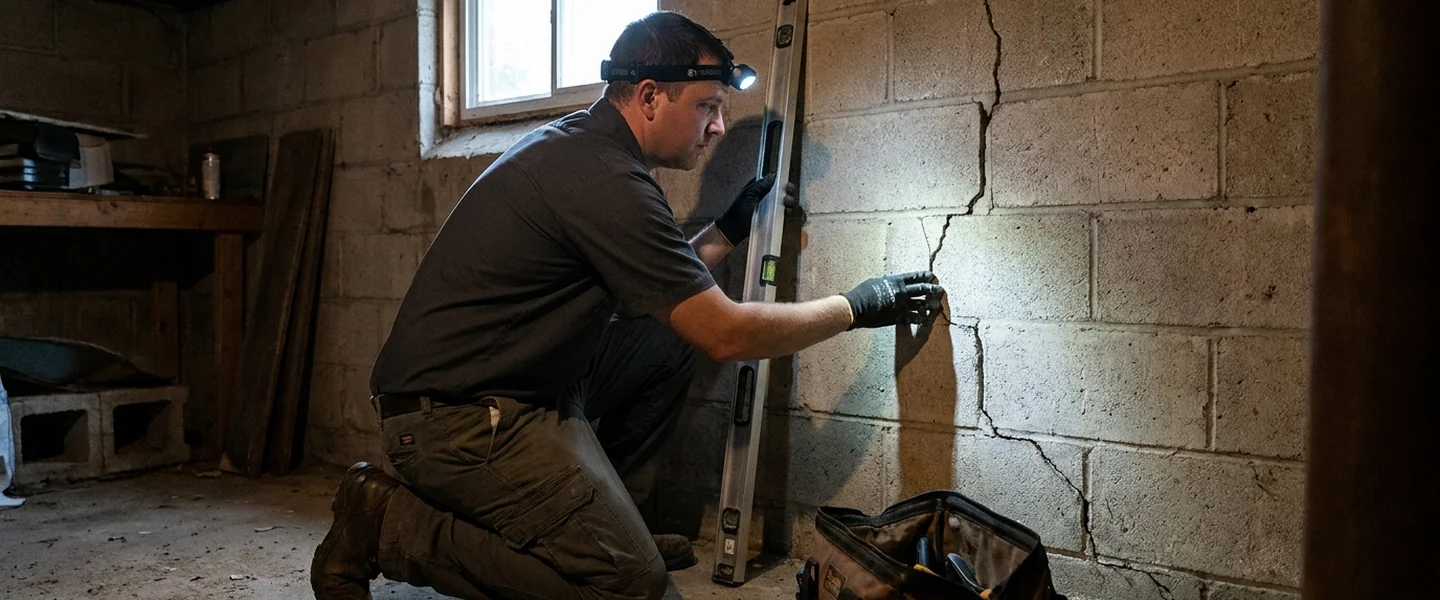
- Sloping floors — floors that are visibly not level, or that "feel" like they run downhill; measurable slope toward the settling section
- Diagonal cracks at door and window corners — 45-degree cracks radiating from the corners of door frames and window openings, caused by the frame racking as the foundation drops
- Doors and windows that stick or don't close properly — the most common complaint homeowners notice first; door frame racking from settlement prevents proper operation
- Gaps between wall and ceiling — the settling section drops while the ceiling doesn't, creating a visible gap along the top of the wall
- Cracks in drywall — diagonal cracks in interior drywall walls, particularly in the corners of rooms over the settling area
- Chimney separation — the chimney, built on its own footing, settles independently from the house and pulls away from the exterior wall
- Basement floor cracks with displacement — floor slab cracks where one side is higher than the other, indicating differential movement below the slab
Our Piering Systems
Steel Push Piers
Steel push piers are the standard solution for foundation settlement in the Indianapolis area. The process uses the weight of the structure itself as the driving force: steel pier sections are driven into the ground below the existing foundation footing, section by section, until they reach refusal — the point at which the pier cannot be advanced further because it has reached a competent bearing stratum. The hydraulic driving equipment reads the resistance at each increment, giving us confirmation of when we've reached stable load-bearing material.
Once the piers are driven to refusal, they're connected to the foundation footing via a steel bracket system. The load is then transferred from the footing to the pier — and the pier carries that load down to the stable strata. In most Indianapolis installations, we can simultaneously stabilize the foundation and recover some or all of the lost elevation by hydraulically lifting the settled section. The lift brings the foundation back toward its original position, closing cracks, re-aligning door frames, and restoring the floor level.
Helical Piers
Helical piers use a screw-in action rather than driven force — a steel shaft with helical plates is rotated into the soil using a hydraulic drive head. The helical plates thread through the soil like a screw, reaching load-bearing strata without relying on the structural weight above for driving force. This makes helical piers the right choice for new construction, additions, lightweight structures, or any situation where push pier driving force isn't available.
Helical piers are also appropriate for soils with layers that don't allow push pier advancement — if there's a soft layer followed by hard material, helical piers thread through the soft layer without the resistance-based driving limitation that affects push piers. We assess subsurface conditions during the site visit to determine which pier type is appropriate.
Slab Piering
Basement floor slabs and interior slabs can be piered from below using mini piers or helical micro-piles installed through cores drilled in the slab. This approach addresses situations where the slab itself is settling — distinct from the perimeter foundation wall settling. Interior slab piering stabilizes the floor without the major disruption of a full slab replacement.
Project Details
| Installation Timeline | 1–3 days depending on pier count and site access |
|---|---|
| Excavation Required | Small access pits at pier locations (approximately 2×2 ft), no major excavation |
| Pier Depth | Driven to refusal at load-bearing strata — typically 15–30+ feet in Central Indiana |
| Elevation Recovery | Hydraulic lift attempted at pier installation; recovery amount depends on settlement extent and structural constraints |
| Structural Load Transfer | Foundation load transferred from unstable near-surface soils to deep load-bearing strata |
| Warranty | Transferable lifetime warranty against further foundation settlement at piered locations |
| Pricing | Quoted per job after free on-site assessment — scope depends on pier count, depth, and site conditions |
Our Foundation Piering Process
- 1Settlement Assessment — We measure floor levels throughout the affected area, identify the settling section of the foundation, assess the crack pattern and structural impact, and determine pier locations and count. In some cases we recommend a soil borings report for deep subsurface characterization; we'll tell you if that's warranted.
- 2Written Estimate — Complete written estimate: pier count, pier type (push vs. helical), expected depth to refusal, access pit count, elevation recovery goal, and warranty terms. No open-ended "we'll see what we find" pricing.
- 3Access Pit Excavation — Small pits opened at each pier location to expose the foundation footing. Typically 2×2 feet, hand-dug or with a small excavator. Soil removed and staged for backfill.
- 4Pier Driving — Steel pier sections advanced using hydraulic equipment. Driving resistance monitored continuously. Pier installation complete when refusal criteria met at each location. Refusal depth recorded for documentation.
- 5Bracket Installation and Hydraulic Lift — Pier bracket installed at each footing location. All piers connected simultaneously. Hydraulic jacks applied uniformly across all brackets; foundation raised incrementally, monitoring level throughout the lift. Lift locked off at maximum recovery or structural limit.
- 6Backfill and Documentation — Access pits backfilled and compacted. Site cleaned. Elevation readings documented before and after. Warranty registered to property address. Follow-up inspection scheduled at 30 days.
Indianapolis-Specific Piering Considerations
Central Indiana's glacial geology creates a specific subsurface profile that affects piering depth. The near-surface soils — typically 10–20 feet of glacially deposited clay, silt, and sand — are compressible and moisture-sensitive. Below this layer, most of Central Indiana has glacial till or dense sand and gravel deposits that provide excellent bearing capacity. Push piers in the Indianapolis metro typically reach refusal between 15 and 30 feet, sometimes deeper in areas with thicker surface clay deposits.
The White River corridor — including parts of Broad Ripple, Irvington, and the Westside — has areas where organic material (old river deposits, filled wetlands) is present below the surface soils. These organic layers are highly compressible and can cause significant long-term settlement as they continue to consolidate. Homes built in the 1950s and 1960s near waterways often have settlement problems rooted in this subsurface organic layer that only becomes fully apparent decades later. Piering through these layers to the dense material below is the only permanent solution.
Carmel and Fishers new construction has a different piering profile: settlement in newer homes is often caused by inadequate compaction of fill soils placed during site development rather than natural soil failure. Fill soils can settle for years after construction as the material continues to consolidate under load. Piering through the fill to the undisturbed natural soils or glacial till below stops the settlement permanently.
Warranty in Detail
Our foundation piering installations carry a transferable lifetime warranty against further settlement at piered locations. If the piered section of foundation moves downward after installation, we return and address it at no charge. The warranty transfers to new owners at the time of home sale — an important disclosure item for buyers that the foundation settlement has been professionally addressed with permanent structural support.
What the warranty covers: downward movement of the piered foundation section. What it doesn't cover: settlement in unpiered sections of the foundation (adjacent footings, interior slabs, or areas not included in the piering scope), lateral movement of the foundation (piering is a vertical load transfer system — horizontal movement requires bowing wall stabilization), cosmetic cracking in drywall or plaster from temperature cycling unrelated to foundation movement, and damage from events outside the scope of the original settlement (new plumbing leak beneath the slab, new tree root intrusion, etc.).
How We Quote Foundation Piering
Piering quotes are based on the number of piers required, pier type, estimated depth to refusal (which determines material cost), site access, and any associated crack repair in scope. We determine pier count from the settling section length and the load distribution analysis — more piers closer together is more expensive but distributes load more evenly. We don't pad pier counts to increase the invoice, and we don't undercount and then discover we need more mid-job. Call (317) 676-5519 to schedule your free on-site assessment.
Foundation Piering FAQ — Indianapolis, IN
Can you lift my foundation back to its original level?
In many cases, partial or full elevation recovery is possible during pier installation. We apply hydraulic lifting force simultaneously across all installed piers and raise the foundation incrementally while monitoring the structure. Recovery is limited by several factors: the amount of differential settlement, how long the settlement has been occurring (older settlement may have caused secondary cracking or structural connections that resist lift), and what the structure above can tolerate. We give you a realistic expectation of recovery potential during the assessment — not a promise we can't keep.
How many piers does my house need?
Pier count depends on the settling section length, the load of the structure above, and the bearing capacity we're targeting at the pier tips. A typical residential footing section might require one pier every 6–8 feet. We calculate the required pier spacing and count from the footing load and the expected pier capacity at your site's bearing stratum depth. We present the full pier count in the written estimate before any work begins.
What's the difference between push piers and helical piers?
Push piers are driven into the ground using the weight of the structure as the driving force — hydraulic equipment pushes the pier down until it reaches resistance. Helical piers are screwed in like a giant screw — the helical plates thread through soil layers. Push piers are typically faster to install and the resistance measurement gives precise confirmation of bearing capacity. Helical piers are appropriate for lighter structures, new construction (where there's no existing load to use as driving resistance), or subsurface profiles where threading past soft layers is required. We assess your situation and recommend the correct type.
Do push piers require digging up my yard or driveway?
Pier installation requires small access pits at each pier location — typically 2 feet square and 2–3 feet deep to expose the footing. These are not full trenches or major excavations. If piers are located under a driveway or concrete walkway, we core through the concrete to reach the footing. The pits are backfilled and compacted after installation. Concrete that was cored for access is patched. The disturbance is far less than full exterior excavation waterproofing or traditional underpinning approaches.
My house has been settling for years — is it too late for piering?
Settlement is a continuous process, not a point-in-time event. As long as the structure above is still in serviceable condition (not so severely compromised that the framing is at risk of failure), piering can stop further settlement and recover elevation. The longer settlement continues, the more secondary damage accumulates (cracked plaster, racked doors, stressed connections), but the piering solution itself doesn't become less viable just because more time has passed. Get an assessment and know where you stand.
Will piering fix my sloping floors?
Piering stops future movement and can recover lost elevation during installation, but it can't undo every cosmetic consequence of past settlement. Sloping floors caused by settling foundations will improve if we recover the elevation. Cracked drywall, racked door frames, and sticking doors may need separate cosmetic repair after the foundation is stabilized — piering addresses the structural cause, not the cosmetic effects. We discuss realistic expectations during the assessment.
Is foundation piering covered by homeowners insurance?
Settlement and earth movement are typically excluded from standard homeowners policies. Some policies have specific riders for sudden structural events, but gradual settlement from soil consolidation is usually not covered. Foundation disclosure requirements in Indiana mean that settlement history and repairs need to be disclosed at resale — a properly documented, warranted piering repair is a much stronger disclosure position than undocumented ongoing settlement.
How long does piering installation take?
Most residential piering projects complete in 1–3 days. A 6–8 pier project on a settled corner with good access typically takes one day. Larger projects with 12+ piers, complex site access, or interior slab piering may require 2–3 days. We give you a specific timeline in the written estimate based on your pier count and site conditions.
Foundation Piering — Indianapolis Metro
Push piers and helical piers. Permanent load transfer. Settlement recovery. Transferable lifetime warranty. Free on-site estimate.
Call (317) 676-5519Related Services
What You Get in Our Quote vs. the Lowball Bid
We don't compete on the lowest sticker price — we compete on the quote that gets the job actually done. Here is what is included in every quote we write, and the cut-corners that show up in cheaper bids.
Included in our written quote
- Engineer-style elevation + crack assessment
- Soil and drainage evaluation
- Written quote with pier counts + warranty terms
- Photo documentation of every crack/movement
- Permit-pulling where required
- Post-install elevation re-check
Cut corners in the lowball bid
- Free-quote with no actual inspection
- Pier-count guesses without measurements
- Subcontracted installation crews
- Warranties that exclude common failure modes
- Pressure to sign at the kitchen table
- Same-day pricing tricks