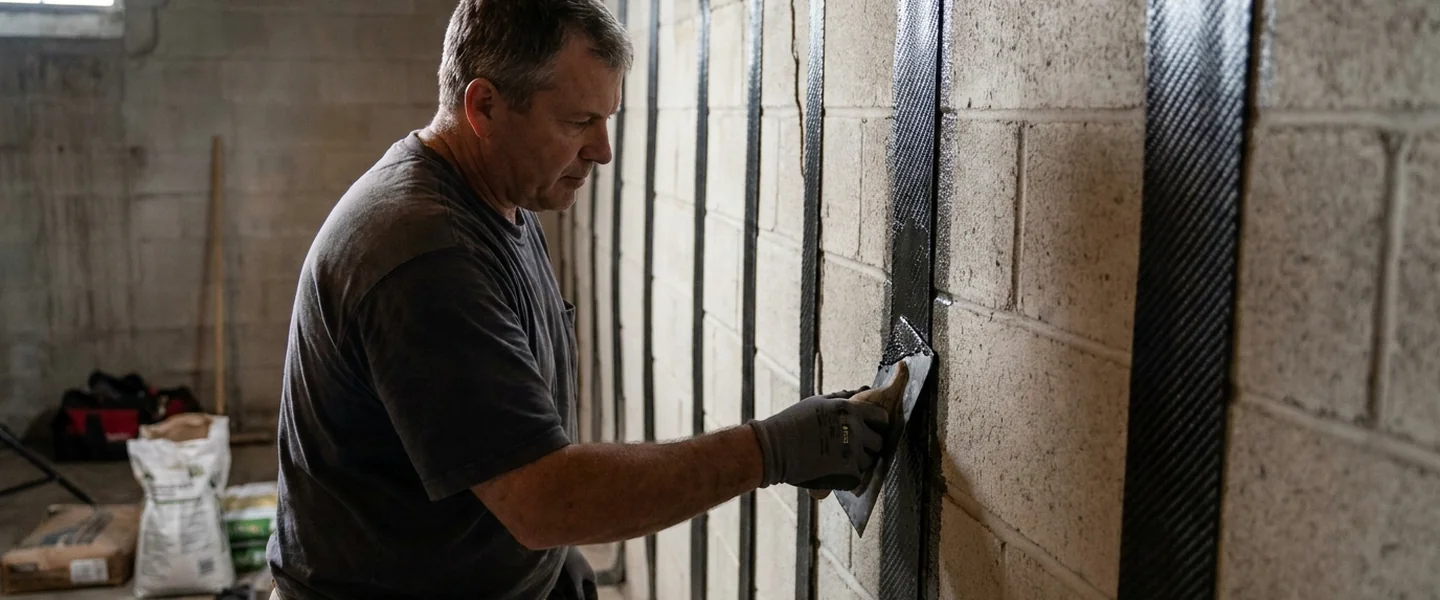
Bowing Wall Stabilization in Indianapolis, IN
Carbon fiber straps and wall anchor systems for bowing or leaning foundation walls. No excavation. Stops movement immediately — straightens over time. Transferable lifetime warranty.
Call (317) 676-5519Bowing foundation walls are one of the most serious structural problems Indianapolis homeowners encounter — and one of the most urgent to address. When a basement wall begins bowing inward, it means the lateral pressure from the surrounding soil has exceeded the wall's capacity to resist it. Left unaddressed, bowing progresses: the wall continues to move, cracks widen, and what starts as a manageable repair becomes a wall replacement or full foundation reconstruction. Indianapolis Foundation Pros installs carbon fiber strap systems and wall anchor systems that immediately halt inward movement and, over time, allow the wall to be gradually straightened.
The mechanics behind bowing walls in the Indianapolis metro are straightforward: Indiana's clay soils become extremely heavy when saturated. The lateral pressure from saturated clay against a basement wall can reach hundreds of pounds per square foot. Foundation walls — particularly the concrete block foundations common in Indianapolis homes built between the 1950s and 1980s — were not designed to resist decades of this seasonal loading cycle. The wall gives way at its weakest point, typically mid-span, creating the characteristic inward bow that homeowners notice as a curved or angled wall.
Signs Your Foundation Wall Is Bowing
- Horizontal cracks — a horizontal crack running across the wall is the most definitive sign of bowing; it marks where the wall is bending
- Stair-step cracks in block walls — in concrete block foundations, the mortar joints fail in a stair-step pattern as the wall rotates inward
- Wall curves inward visibly — you can see or measure an inward curve when looking along the wall face
- Increased moisture intrusion — wall movement opens cracks that admit water, so new or worsening water intrusion often accompanies bowing
- Doors and windows sticking — wall movement can transfer to the structure above, causing the first-floor door and window frames to rack
- Gaps at floor-wall junction — as the wall rotates inward at mid-height, the top and bottom of the wall may pull away from the floor and ceiling
Any inward deflection of 1 inch or more warrants prompt professional assessment. Deflection of 2 inches or more is considered severe and indicates the wall is close to the limit of what can be stabilized without replacement. Don't delay — every wet season adds more movement.
Our Stabilization Methods
Carbon Fiber Strap System
Carbon fiber straps are our primary bowing wall stabilization method for walls with deflection up to approximately 2 inches. Carbon fiber is stronger in tension than steel at a fraction of the weight — a 4-inch-wide carbon fiber strap anchored at the top and bottom of the wall creates a rigid tie that prevents any further inward movement. The system works immediately upon installation: the wall cannot move past the strap's anchor points.
Installation is non-invasive. The strap is adhered to the interior face of the wall using structural epoxy, anchored to the first-floor framing at the top and to the basement floor at the bottom. No excavation. The strap is low-profile (about 1/8 inch thick) and can be covered with drywall or left exposed. Multiple straps are spaced across the wall — typically every 4 to 6 feet — to distribute the load across the full wall length. After installation, the wall can be gradually straightened by tightening the anchor mechanism at annual intervals during dry soil conditions.
Wall Anchor System
Wall anchors are used for walls with greater deflection or when the soil conditions allow placement of the anchor plate at sufficient distance from the foundation. The system consists of a wall plate installed against the interior face of the wall, a steel rod driven horizontally through the wall into the surrounding soil, and an anchor plate buried in the soil at a distance from the foundation. Tightening the rod connection gradually pulls the wall back toward its original position over time.
Wall anchors require some exterior access to install the buried anchor plate — a small area of soil disturbance outside the wall, rather than full excavation. The exterior disturbance is minimal compared to full excavation waterproofing approaches. Wall anchors offer the advantage of active straightening potential, pulling the wall back incrementally with annual adjustments as the soil allows.
I-Beam Bracing
For walls with severe deflection or walls that are too far gone for carbon fiber alone, steel I-beam bracing provides the maximum stabilization force. I-beams are installed vertically against the interior wall face, anchored floor to ceiling, and resist the full lateral pressure of the surrounding soil. I-beam systems don't allow for straightening but provide the highest resistance to further movement — appropriate for walls that need to be held while the homeowner plans a longer-term resolution.
Project Details
| Installation Timeline | 1 day for carbon fiber strap systems; wall anchors may require 1–2 days |
|---|---|
| Excavation Required | None for carbon fiber; minimal exterior access for wall anchor plate installation |
| Strap Spacing | Typically every 4–6 feet across the bowing wall section |
| Straightening | Gradual straightening possible with annual adjustment during dry soil conditions |
| Applicable Deflection | Carbon fiber: up to ~2 inches; wall anchors: greater deflection or active straightening goal |
| Warranty | Transferable lifetime warranty against further inward wall movement |
| Pricing | Quoted per job after free on-site assessment — scope depends on wall length, deflection measurement, and method |
Our Bowing Wall Stabilization Process
- 1Structural Assessment — We measure the inward deflection at multiple points, identify the crack pattern, assess the wall type (poured concrete vs. block) and thickness, and determine whether the underlying cause is soil pressure, drainage, or both. The deflection measurement establishes whether carbon fiber, wall anchors, or I-beams are appropriate.
- 2Written Estimate — Complete written estimate: strap count and spacing, anchor type, total wall linear footage, installation timeline, and warranty terms. We don't add scope mid-job.
- 3Wall Preparation — Existing cracks noted and photographed. Wall surface cleaned and prepped for epoxy adhesion (for carbon fiber systems). Any loose mortar or spalled concrete addressed so the strap bonds to a solid substrate.
- 4Strap or Anchor Installation — Carbon fiber straps adhered with structural epoxy at correct spacing, anchored to floor framing and basement floor. Wall anchors: wall plate installed, rod driven, exterior anchor plate installed and buried. All anchor points tightened to design spec.
- 5Crack Injection (If Applicable) — Any horizontal or associated cracks injected with polyurethane or epoxy per the crack type. A stabilized wall that still has open cracks continues to admit water — crack repair and wall stabilization work together.
- 6System Verification and Warranty — All anchor points verified. Straightening adjustment schedule provided. Warranty documentation registered to your property address. Return visit scheduled for first annual adjustment check.
Indianapolis-Specific Bowing Wall Considerations
Concrete block foundations — prevalent in Indianapolis neighborhoods built from the 1950s through the late 1970s — are more susceptible to bowing than poured concrete because block walls have mortar joints that are inherently weaker than a solid poured wall. The hollow cores of the blocks also fill with water, adding weight and hydrostatic pressure within the wall itself. In heavily block-foundation neighborhoods like Lawrence, Beech Grove, Greenwood's older sections, and Speedway, we see bowing and stair-step cracking as the dominant structural failure mode.
The Greenwood and Johnson County area — including Bargersville and Whiteland — has particularly heavy clay soil with high plasticity. After a wet spring, this soil can exert exceptional lateral pressure on foundation walls, and we frequently see bowing progression that occurs primarily during April and May. If you noticed your wall "got worse" after this past spring, that's consistent with what the soil conditions produce every year.
Hamilton County (Carmel, Fishers, Noblesville) has extensive landscaping irrigation in established subdivisions that keeps soil moisture elevated year-round. Walls in these areas don't get the summer relief that walls in drier locations experience — they're under continuous hydrostatic pressure from irrigation-maintained soil moisture. This sustained pressure accelerates bowing progression in walls that are already showing deflection.
Warranty in Detail
Our bowing wall stabilization warranty covers further inward wall movement through the stabilized section for the lifetime of the installation. If the wall moves further inward past the stabilized position after our installation, we return and address it at no charge. The warranty transfers to new owners — they inherit the documented structural repair and ongoing coverage.
What the warranty covers: inward movement of the wall past the position at the time of installation. What it doesn't cover: movement in untreated wall sections (walls adjacent to the repaired section that weren't included in the scope), outward movement (rare, but possible if the soil-side pressure is released and the wall springs back), damage from new structural events not related to the original bowing mechanism, and cosmetic surface changes to the strap or epoxy that don't indicate structural movement.
How We Quote Bowing Wall Stabilization
The quote depends on the bowing wall length (linear footage of straps or anchors), the deflection measurement (which determines the appropriate method), the wall type (block vs. poured concrete — they have different prep requirements), and whether crack injection is in scope. We measure the deflection on-site because "my wall looks bowed" doesn't tell us whether we're dealing with 1/2 inch of deflection or 2 inches — a difference that determines the right repair system. Call (317) 676-5519 to schedule your free on-site assessment.
Bowing Wall Stabilization FAQ — Indianapolis, IN
How much inward bowing is too much to repair?
There's no hard cutoff, but general industry guidance is that walls with more than 2 inches of inward deflection are approaching the limit of what can be stabilized vs. replaced. Between 2 and 3 inches, stabilization may still be possible with a combination of wall anchors and I-beam bracing, but the repair is more involved and the long-term prognosis is more cautious. Beyond 3 inches of deflection, wall reconstruction may be the more reliable long-term solution. We give you an honest assessment of where your wall falls on this spectrum during the site visit.
Can a bowing wall be straightened back to its original position?
Partially, over time. Carbon fiber straps and wall anchors arrest movement immediately, but straightening is a gradual process — the wall is returned toward its original position incrementally, typically 1/4 inch per annual adjustment as the soil conditions allow. Full straightening back to original plumb position is the goal but isn't always achievable depending on deflection severity and soil conditions. A wall that's stabilized and partially straightened over 2–3 years is a successful outcome.
Will the carbon fiber strap interfere with finishing my basement?
No — the strap is low-profile (about 1/8 inch) and can be drywalled over. In a finished basement, the strap is not visible after the framing and drywall are installed. If you're planning to finish your basement after stabilization, the strap doesn't require any special framing accommodation beyond keeping the framing wall slightly off the foundation wall as you would anyway for insulation.
My wall has been bowing for years — is it too late?
Probably not, but the degree of existing deflection matters. If you've noticed bowing for several years without addressing it, the deflection has progressed from where it started — but as long as it's under approximately 2–2.5 inches, stabilization is still the right approach. The risk of waiting is that every wet season adds more movement, and the wall that's repairable today may cross into replacement territory after another spring. Get an assessment now so you know where you stand.
Should I repair the bowing wall before selling my house?
Yes — a documented bowing wall repair with a transferable warranty is worth substantially more than an unrepaired wall at the negotiating table. Buyers and their inspectors will flag bowing; lenders will sometimes decline to finance properties with significant foundation movement. A repaired, warranted wall puts you in a much stronger position at closing. We can often complete the repair in 1–2 days, making it a practical pre-listing repair.
Do you need to excavate to install the wall anchors?
Wall anchors require a small area of exterior soil disturbance — approximately 1–2 square feet where the anchor plate is buried outside the wall. This is not the same as full excavation. The rod is driven horizontally through the wall using a pneumatic tool; the exterior only requires hand-digging to place the anchor plate. Landscaping disturbance is minimal and the area can be restored after installation. Carbon fiber straps require zero exterior disturbance.
How is bowing wall stabilization different from waterproofing?
They address different problems that often coexist. Bowing wall stabilization stops structural movement — it prevents the wall from continuing to bow inward. Basement waterproofing manages water that enters through the wall. Many bowing walls also have water intrusion, so both problems need to be addressed. We assess both conditions and tell you which repair sequence is appropriate — typically, structural stabilization first, then water management. The two systems work together.
Is bowing wall stabilization covered by homeowners insurance?
Typically not for gradual movement from soil pressure, which insurers classify as settlement or earth movement — generally excluded from standard homeowners policies. Sudden events (like a basement flood that soaked the soil and caused rapid wall movement) may have a claim depending on your policy terms. We provide documentation for insurance purposes, but coverage determination is your insurer's call.
Bowing Wall Stabilization — Indianapolis Metro
Carbon fiber straps and wall anchors. No excavation. Stops movement immediately. Transferable lifetime warranty. Free on-site estimate.
Call (317) 676-5519Related Services
What You Get in Our Quote vs. the Lowball Bid
We don't compete on the lowest sticker price — we compete on the quote that gets the job actually done. Here is what is included in every quote we write, and the cut-corners that show up in cheaper bids.
Included in our written quote
- Engineer-style elevation + crack assessment
- Soil and drainage evaluation
- Written quote with pier counts + warranty terms
- Photo documentation of every crack/movement
- Permit-pulling where required
- Post-install elevation re-check
Cut corners in the lowball bid
- Free-quote with no actual inspection
- Pier-count guesses without measurements
- Subcontracted installation crews
- Warranties that exclude common failure modes
- Pressure to sign at the kitchen table
- Same-day pricing tricks