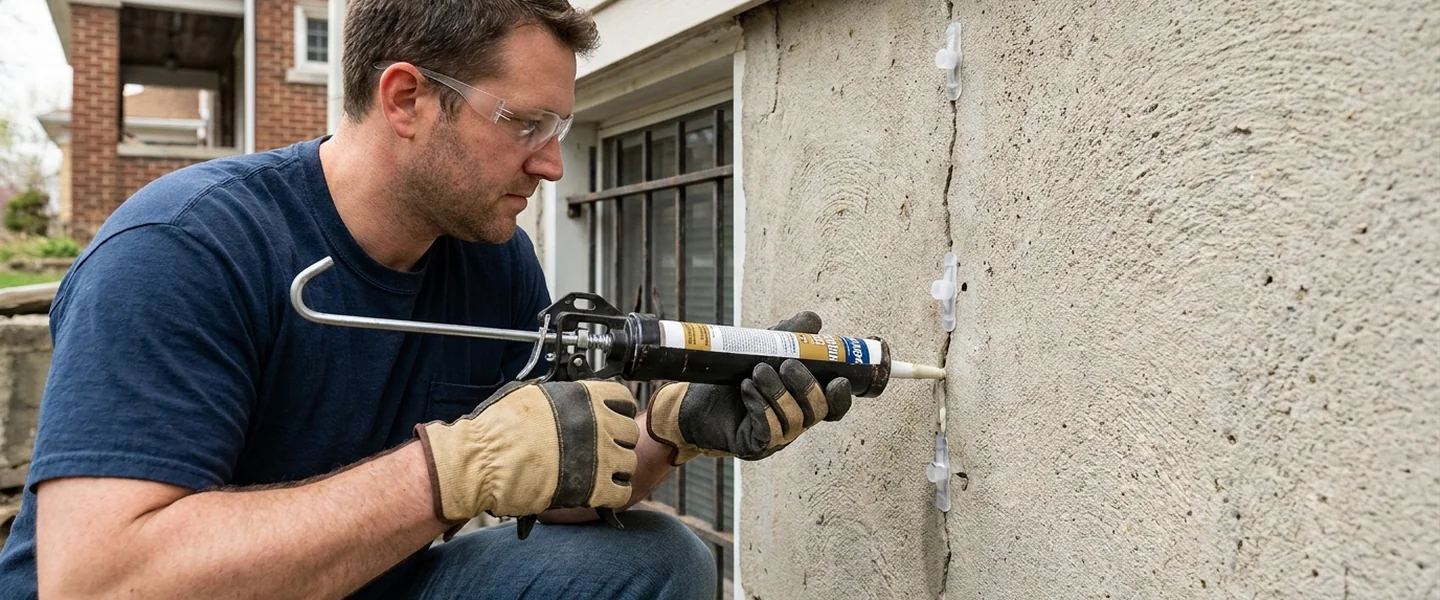
Foundation Crack Repair in Indianapolis, IN
Polyurethane and epoxy injection for active and dormant foundation cracks. No excavation — sealed from the inside. Transferable lifetime warranty. Free on-site estimate.
Call (317) 676-5519Foundation cracks are one of the most common issues facing Indianapolis homeowners — and one of the most misunderstood. Not every crack signals a structural emergency, but no crack should be ignored. Indianapolis's clay soils expand and contract with seasonal moisture changes, creating constant lateral and vertical stress on foundation walls. Over time, that stress finds its outlet in cracks — and once a crack forms, it becomes a pathway for water, radon, and progressive structural movement. Indianapolis Foundation Pros repairs foundation cracks using injection methods that seal the crack from the inside out, restoring the structural integrity of the wall without excavation.
The right repair method depends on what the crack is doing. An active crack — one that's still moving with seasonal soil shifts — requires a flexible repair that can accommodate that movement. A dormant crack — one that has stabilized — can be rigidly sealed. We assess every crack before recommending an injection method, because using the wrong material on the wrong crack type is how "repaired" cracks re-open within a season.
Why Indianapolis Foundations Crack
Indianapolis sits on glacially deposited clay soils that behave dramatically differently wet versus dry. When spring rains saturate the soil against your foundation, the clay swells and pushes laterally against the wall. When summer heat dries that same soil, it contracts and pulls away — creating gaps that allow water to rush in during the next rain event. This wet/dry cycling repeats every year, and the cumulative movement is what drives foundation cracking.
The most common crack types we see in Indianapolis-area homes:
- Vertical cracks — typically caused by concrete shrinkage or differential settlement; usually not structurally concerning but must be sealed to prevent water intrusion
- Diagonal (stair-step) cracks — often indicate differential settlement, where one corner or section of the foundation is dropping faster than another; more significant and require evaluation
- Horizontal cracks — the most serious type; caused by lateral soil pressure bowing the wall inward; indicate the wall may be structurally compromised and require more than just crack injection
- Cracks at window and door openings — stress concentrations at corners of openings where the wall is thinner; common in poured concrete and block foundations alike
- Floor slab cracks — caused by differential settlement, clay shrinkage below the slab, or hydrostatic pressure; range from cosmetic to structural depending on width and displacement
Indianapolis homes built from the 1940s through the 1970s — particularly in areas like Irvington, Broad Ripple, Southport, and Lawrence — have poured concrete and concrete block foundations that have now been subjected to decades of Indiana's clay soil cycling. These older foundations have had more cumulative movement and tend to have more cracks than newer construction. We see a disproportionate share of crack repair calls from these neighborhoods during the spring and after dry summers.
Our Crack Repair Methods
Polyurethane Injection — For Active and Wet Cracks
Polyurethane injection is our standard method for cracks that are actively admitting water or are likely to continue moving with seasonal soil shifts. Polyurethane foam expands as it cures, filling the full depth of the crack — including any voids behind the wall face that the crack has opened up. The cured foam remains flexible, able to accommodate minor seasonal movement without re-cracking. This is the correct choice for most Indianapolis residential foundation cracks because the soil movement that created the crack doesn't stop after repair — the material needs to flex with it.
The process: we drill injection ports into the crack at 6–12 inch intervals, inject a low-viscosity polyurethane resin at low pressure, and the material travels through the crack from port to port until the crack is filled. The ports are then capped and the surface is ground smooth. No excavation. No disruption to landscaping. Work completed from inside the basement.
Epoxy Injection — For Structural Restoration
Epoxy injection is used when the goal is structural restoration — making the cracked section of wall as strong as or stronger than the original concrete. Epoxy cures rigid and bonds with extremely high strength to concrete surfaces. The appropriate choice for dormant cracks in load-bearing sections of the wall, cracks in areas where rigid repair won't be compromised by future movement, and any situation where the structural capacity of the wall section must be fully restored. Epoxy is not the correct choice for actively moving cracks — it will crack again at the same location as the underlying movement continues.
Carbon Fiber Staples for Crack Bridging
For cracks that show signs of displacement — where one side of the crack has moved relative to the other — we use carbon fiber staples in addition to injection. The staples are installed perpendicular to the crack, bridging it and preventing the two sides from moving independently. This technique is particularly useful for diagonal cracks associated with differential settlement where the settlement has stabilized but the crack edges are slightly displaced.
Project Details
| Repair Timeline | Same day for most crack repairs; multiple cracks on one visit |
|---|---|
| Excavation Required | None — all work completed from inside the basement |
| Materials | Polyurethane resin (active/wet cracks) or structural epoxy (dormant/structural cracks) |
| Injection Ports | Drilled at 6–12 inch intervals; capped and sealed after injection |
| Surface Finish | Ports ground flush; crack surface covered with epoxy cap coat |
| Warranty | Transferable lifetime warranty against re-entry of water through the repaired crack |
| Pricing | Quoted per job after free on-site assessment — scope depends on crack length, width, and activity |
Our Crack Repair Process
- 1Crack Assessment — We evaluate each crack: length, width, displacement, whether it's active (moving seasonally) or dormant, whether water intrusion is present, and what caused the crack in the first place. Crack type and behavior determine the repair method — not a standard upsell to the most expensive option.
- 2Written Estimate — Flat written estimate covering number of ports, injection material (polyurethane vs. epoxy), any carbon fiber stapling, and warranty terms. The estimate is complete before we drill the first port.
- 3Port Installation — Injection ports drilled at correct spacing for the crack width and expected resin travel distance. Port placement is critical — too far apart and sections of the crack fill incompletely.
- 4Resin Injection — Low-pressure injection starting at the lowest port and working upward. We monitor resin travel from port to port to confirm the crack is filling completely. Injection continues until the resin is confirmed throughout the crack depth.
- 5Cap Coat and Cleanup — Ports capped, cap coat applied over the crack face, surface ground smooth. Cleanup completed before we leave. No concrete debris, no resin mess.
- 6Warranty Documentation — Warranty registered to your property address at job completion. Documentation includes the crack location, repair method, and coverage terms for future reference at resale.
Indianapolis-Specific Crack Repair Considerations
Concrete block foundations — common in Indianapolis neighborhoods built between the 1950s and 1980s — crack differently than poured concrete. Mortar joints between blocks are the weak point: water migrates through the mortar long before the blocks themselves fail. Block foundations in Lawrence, Beech Grove, and Southport frequently show mortar joint deterioration that presents as cracking and water intrusion through the joint pattern. Injection repair on block foundations requires filling not just the visible crack but the mortar joint system along the cracked section.
Homes in lower-lying neighborhoods near White River, Fall Creek, and Eagle Creek reservoir — including parts of Irvington, Broad Ripple, and the near-Westside — have seasonally elevated water tables that put hydrostatic pressure on foundation walls. Cracks in these locations are under constant outward pressure from water rather than just from soil expansion. Crack repair in high-water-table situations requires attention to the drainage system context: sealing the crack without addressing the drainage source may redirect the pressure to create a new crack nearby. We address this by assessing whether basement waterproofing is part of the correct repair scope before recommending crack injection alone.
Hamilton County suburbs — Carmel, Fishers, Noblesville — have a higher proportion of newer poured-concrete foundations (1990s and newer) that show shrinkage cracks from the initial curing process rather than stress-induced cracks. These shrinkage cracks are typically dormant, narrow, and well-suited for epoxy injection. The main risk in these foundations is water intrusion during Indiana's heavy spring rains, not ongoing structural movement.
Warranty in Detail
Our crack repair warranty covers re-entry of water through the repaired crack for the lifetime of the repair. If a repaired crack begins admitting water again at the injected location, we return and re-inject at no charge. The warranty transfers to new owners automatically at the time of home sale — providing documentation for buyers and their inspectors that the crack was professionally repaired and carries ongoing coverage.
What the warranty covers: water re-entry through the injected crack at the repaired location. What it doesn't cover: new cracks that develop elsewhere in the wall (different structural events create different cracks), crack re-opening that results from new structural movement significant enough to exceed the repair material's capacity (horizontal bowing cracks that continue to move because the underlying bowing is untreated — in these cases, bowing wall stabilization is the correct prior repair), and surface cosmetic re-cracking of the cap coat from temperature cycling without underlying water intrusion.
How We Quote Foundation Crack Repair
Crack repair quotes depend on the number of cracks, the total crack length, the crack width (which determines port spacing and resin volume), the repair material (polyurethane vs. epoxy), and whether carbon fiber stapling is indicated. We don't quote crack repair over the phone because crack width, activity, and water intrusion status can't be assessed from a description. Call (317) 676-5519 to schedule your free on-site assessment — we'll evaluate every crack, explain what each one means structurally, and give you a written estimate before any work begins.
After Your Foundation Crack Is Repaired
The repaired crack is sealed immediately — there's no cure delay before the wall is watertight. Polyurethane repairs are effective as soon as the resin cures (a matter of hours); epoxy injection reaches full structural strength within 24–48 hours depending on temperature. You can proceed with any planned finishing work — framing, drywall, painting — after the surface is smooth.
Monitor the repaired area during the first heavy rain after repair to confirm the seal is complete. In our experience this is rarely an issue — a properly injected crack is thoroughly sealed — but it's good practice to check. At 30 days, we do a follow-up contact to confirm you're satisfied with the result. If you're concerned about any aspect of the repair during that period, call us and we'll revisit the site at no charge.
If you have multiple cracks that weren't all addressed in the initial repair (sometimes a homeowner wants to start with the most active cracks and address cosmetic ones later), document them so we can complete the repair scope in a future visit. Unrepaired cracks continue to admit water — the most economical approach is to address all identified cracks in one visit, but we'll work with your budget and priorities.
Foundation Crack Repair FAQ — Indianapolis, IN
Is every foundation crack serious?
No — but every crack deserves evaluation. Hairline shrinkage cracks (under 1/16 inch wide, no displacement, no water entry) are common in poured concrete foundations and typically don't indicate structural problems. Wide cracks (over 1/4 inch), horizontal cracks, cracks with displacement (one side higher than the other), and any crack actively admitting water are more significant and should be assessed promptly. We'll give you a straight answer about what each crack means — not a scare pitch to sell the most expensive repair.
Can I seal a foundation crack myself with hydraulic cement?
Hydraulic cement and surface-applied sealants are surface patches, not crack repairs. They seal the visible surface but don't penetrate through the crack depth — water pressure behind the wall will push past a surface patch, especially in high-hydrostatic-pressure situations like Indianapolis's spring season. Injection fills the crack from the inside wall face to the outside wall face, which is the only approach that permanently addresses water intrusion through the crack.
Do I need to excavate to repair a foundation crack?
For most residential foundation crack repairs in Indianapolis, no. Injection repair is done entirely from the inside of the basement — no excavation, no landscape disruption. Excavation is only necessary for exterior waterproofing membrane application, which is a separate, more involved process we rarely recommend as the primary crack repair approach. Interior injection is more effective for most crack types and far less expensive.
Why is the crack in my foundation wall horizontal?
Horizontal cracks are the most serious crack type and indicate that the wall is being pushed inward by lateral soil pressure. In Indianapolis's clay soils, a wet spring can generate significant lateral pressure against foundation walls, particularly walls that don't have adequate drainage behind them. Horizontal cracks require more than crack injection — the bowing or inward movement of the wall must be stabilized with carbon fiber straps or wall anchors before or in conjunction with crack sealing. If you have a horizontal crack, schedule an assessment promptly — horizontal movement tends to progress.
Will crack repair documentation help when I sell my house?
Yes — significantly. Home inspectors flag foundation cracks; buyers and their lenders worry about them. A repaired crack with professional documentation and a transferable warranty is substantially less alarming to buyers than an unrepaired crack or a crack that was patched with surface cement. Our warranty transfers to the new owner at no paperwork cost — you notify us of the ownership change at closing, and coverage continues. Buyers' agents in Indianapolis increasingly view transferable structural warranties as a positive differentiator.
My basement has multiple cracks — do I repair them all at once?
Repairing all identified cracks in one visit is more economical than addressing them separately over time — we're already mobilized, already have the injection equipment on-site, and the per-crack cost is lower when multiple cracks are addressed together. We can prioritize if budget requires it (active, water-admitting cracks first; dormant cosmetic cracks second), but our recommendation is a complete repair to eliminate all water entry points simultaneously.
How long does crack repair take?
Most residential crack repair visits take 2–4 hours for 1–3 cracks. Port drilling, injection, and cleanup can be completed in a morning or afternoon in most cases. Longer cracks or cracks requiring carbon fiber stapling may require additional time, which we'll account for in the estimate. We typically schedule crack repair as a same-day or early-week appointment.
Is foundation crack repair covered by homeowners insurance?
Most homeowners policies don't cover foundation crack repair resulting from soil movement, settling, or chronic water infiltration — these are considered maintenance items rather than sudden losses. Damage from a sudden, discrete event (like a broken water main flooding the soil against the foundation) may be covered depending on your policy. We can provide detailed documentation of the crack type, cause assessment, and repair scope if you're pursuing an insurance claim, but we don't determine coverage — your insurance adjuster does.
Foundation Crack Repair — Indianapolis Metro
No excavation. Polyurethane or epoxy injection. Transferable lifetime warranty. Free on-site estimate.
Call (317) 676-5519Related Services
What You Get in Our Quote vs. the Lowball Bid
We don't compete on the lowest sticker price — we compete on the quote that gets the job actually done. Here is what is included in every quote we write, and the cut-corners that show up in cheaper bids.
Included in our written quote
- Engineer-style elevation + crack assessment
- Soil and drainage evaluation
- Written quote with pier counts + warranty terms
- Photo documentation of every crack/movement
- Permit-pulling where required
- Post-install elevation re-check
Cut corners in the lowball bid
- Free-quote with no actual inspection
- Pier-count guesses without measurements
- Subcontracted installation crews
- Warranties that exclude common failure modes
- Pressure to sign at the kitchen table
- Same-day pricing tricks